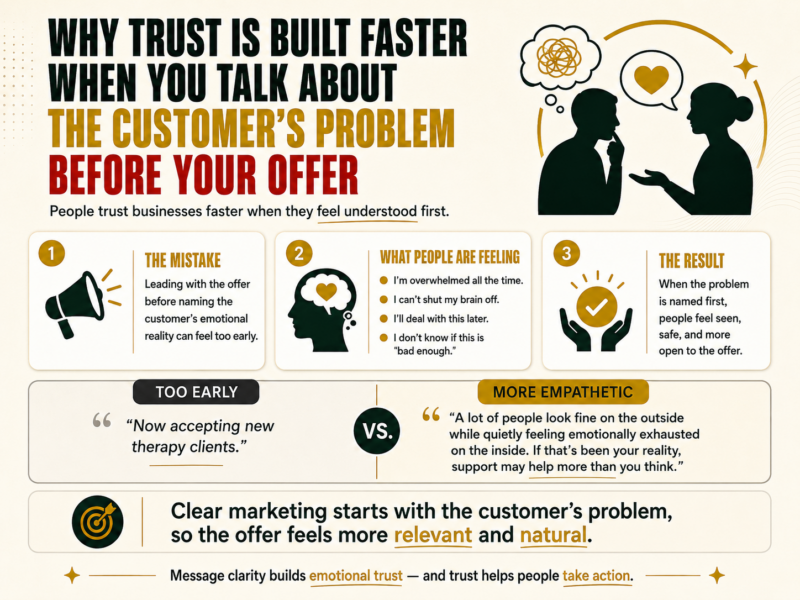
Many businesses make the mistake of leading with the offer too soon.
They talk about availability, services, packages, consultations, and next steps before the customer feels fully understood. The message may be accurate, but it can feel disconnected from what the person is actually experiencing.
This is especially important for service-based businesses where trust matters deeply.
Take a private-pay therapist as an example. Their content may say things like:
“Now accepting new clients.”
“Book your consultation.”
“Therapy can help.”
“Contact us to learn more.”
None of those statements are wrong. But they may not be enough to make someone feel ready to take action.
Meanwhile, potential clients may be walking around thinking:
“I’m overwhelmed all the time.”
“I can’t shut my brain off.”
“I keep telling myself I’ll deal with this later.”
“I don’t know if what I’m feeling is bad enough for therapy.”
That emotional reality matters.
When marketing jumps straight to the offer, it can feel too early. The customer may not yet feel seen, safe, or understood. Before they are ready to book a consultation, they often need language that helps them recognize their own problem and feel less alone in it.
People trust businesses faster when they feel understood first.
That means your marketing should not only explain what you offer. It should also name the problem your customer is living with. When someone reads your content and thinks, “That sounds like me,” trust begins to form.
For the therapist, instead of leading with:
“Now accepting new therapy clients.”
A stronger message might say:
“A lot of people look fine on the outside while quietly feeling emotionally exhausted on the inside. If that’s been your reality, support may help more than you think.”
That message works because it starts with empathy. It names the internal problem. It gives the person language for what they may be feeling. Then, the offer feels more relevant and natural.
This approach applies beyond therapy. A cleaning company should not only say it offers residential cleaning. It should talk about the stress of feeling behind at home. A law firm should not only say it offers estate planning. It should talk about the pressure families feel when important decisions are unclear. A marketing company should not only say it creates content. It should talk about how frustrating it feels when attention does not turn into real inquiries.
Clear marketing starts with the customer’s problem because that is where the customer is already living.
At Next Level DMS, this is why message clarity comes first. The Next Level Story Guide + Convert Kit helps businesses clarify who they help, what problem they solve, and how to communicate in a way that makes customers feel understood before they are asked to take action.
When your content starts with the customer’s real problem, your offer does not feel random. It feels like the next helpful step.
And that is what builds trust faster.