Getting attention is only the first step.
If people are interested in your business but the path to getting started feels confusing, slow, or frustrating, some of them will leave before they ever become customers.
This happens to small businesses more often than they realize.
Take a private-pay fitness coach as an example.
The coach is getting interest from prospects. People are visiting the website, clicking around, reading about the services, and maybe even considering booking. But the process of actually getting started feels clunky.
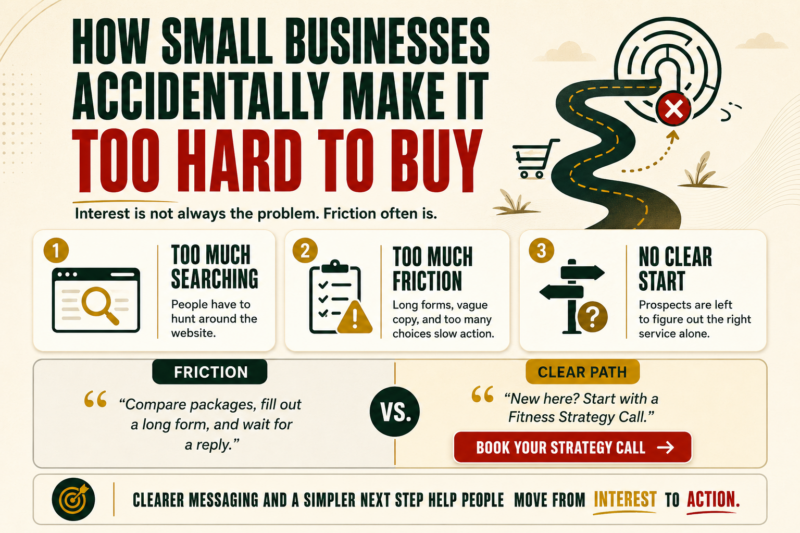
Prospects have to search around the website, read through vague copy, fill out a long form, wait too long for a response, and figure out which service is right for them on their own.
The result? Some people drop off even though they were interested.
The problem is not always the offer. The problem is friction.
Friction is anything that makes it harder for a potential customer to take the next step. It can show up as too many choices, unclear service descriptions, hidden pricing, long forms, weak calls to action, slow follow-up, or a website that makes people work too hard to understand where to begin.
A lot of small businesses focus heavily on generating interest. They post content, run ads, improve their website, network, and try to get more visibility. But they do not always look closely at what happens after someone becomes interested.
That is where opportunities are often lost.
Sometimes people do want to work with you. They just do not know what to do next. Or the next step feels like too much work. Or they are unsure which option fits their needs. When that uncertainty builds, distraction takes over.
A better buying journey should feel simple, clear, and guided.
For the fitness coach, this could mean clearly naming the best starting option for new clients. Instead of making people compare every package on their own, the website could say, “New here? Start with a Fitness Strategy Call.” That immediately gives prospects a clear first step.
The coach could also shorten the intake form. A long form may be useful later, but the first step should be easy enough for someone to complete while motivation is high. The call to action should be obvious on every key page. Follow-up should be fast. And service descriptions should help the prospect understand which option is right for them.
The goal is not to pressure people. The goal is to remove confusion.
At Next Level DMS, this is why message clarity matters so much. The Next Level Story Guide + Convert Kit helps businesses clarify what they offer, who they help, and what step customers should take next, so prospects do not have to figure everything out alone.
A strong marketing system should not only attract attention. It should make action feel easier. Next Level DMS helps small businesses attract and retain customers through message clarity, storytelling, and customer engagement.
If people are interested but not moving forward, do not only ask, “How do we get more leads?”
Ask, “Are we making it too hard for interested people to buy?”
Because when the path is clear, simple, and timely, more people can move from interest to action.