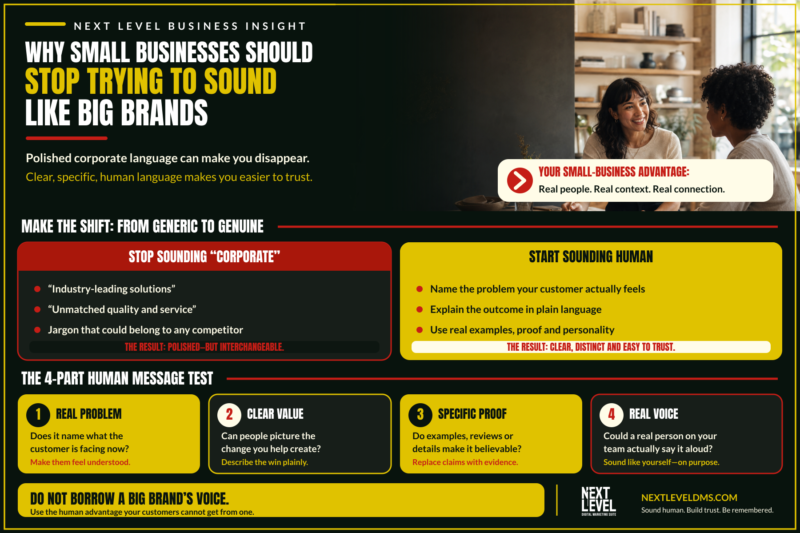
Small-business owners often believe they must sound bigger to be taken seriously. They replace familiar language with corporate phrases, remove the owner’s personality, and make every message feel polished and formal. The result may look professional, but it can also erase the exact reason customers prefer a smaller business.
Professionalism matters. So do clarity, reliability, and consistency. But professional does not have to mean distant. Your authentic small-business brand voice can create something a large company struggles to manufacture: a genuine sense of familiarity, flexibility, and human connection.
When Polished Messaging Loses the Person
Imagine a neighborhood coffee roaster updating its website to sound more premium. Warm descriptions about relationships with customers and local partners are replaced with phrases such as “innovative beverage solutions” and “industry-leading quality.” The new copy sounds bigger—but it could belong to almost any company.
Customers did not love the roaster because it sounded like a national chain. They loved knowing who selected the beans, seeing familiar faces behind the counter, and feeling that the business belonged to the neighborhood. By hiding those qualities, the company removed meaningful differentiation. Clear, specific, and human language can make your small business easier to remember.
Use Language Real Customers Understand
Review your website, emails, and social captions for words you would never say in a real conversation. Replace vague claims such as “exceptional solutions” with specific language about the problem you solve and the experience you provide.
Write as though you are speaking to one best-fit customer. Respect their intelligence, but do not make them translate jargon. Clarity builds trust because people can quickly understand who you help, what you offer, and what happens next.
Make Your Humanity Part of the Strategy
Share the owner’s perspective when it is relevant. Explain why the business exists, what you have learned from serving customers, and what you believe should be better in your industry. Introduce the team, highlight local partnerships, and show the care behind your process.
Human-centered branding does not require oversharing or making every post personal. The goal is to reveal the values, judgment, and relationships that influence how the business works. A family-run restaurant might explain the story behind a recipe. A consultant might share why a common industry practice frustrates clients and how their process handles it differently.
Keep the voice consistent as the team grows. Create a short brand guide with preferred language, phrases to avoid, customer descriptions, tone examples, and the central promise every message should reinforce.
Do Not Hide the Advantages of Being Small
Large companies may have greater reach, but small businesses can listen closely, adapt quickly, remember customers, and invest in community relationships. Those are not weaknesses to disguise. They are strengths to communicate and operational promises to keep.
Ask a loyal customer why they choose you instead of a larger competitor. Their answer may reveal the most believable part of your brand message.
Do not market yourself as a smaller version of a corporation. Small businesses can compete with bigger companies on a different playing field by emphasizing connection, flexibility, and deeper customer value. Next Level DMS can help you turn that truth into a clear brand voice and marketing system.