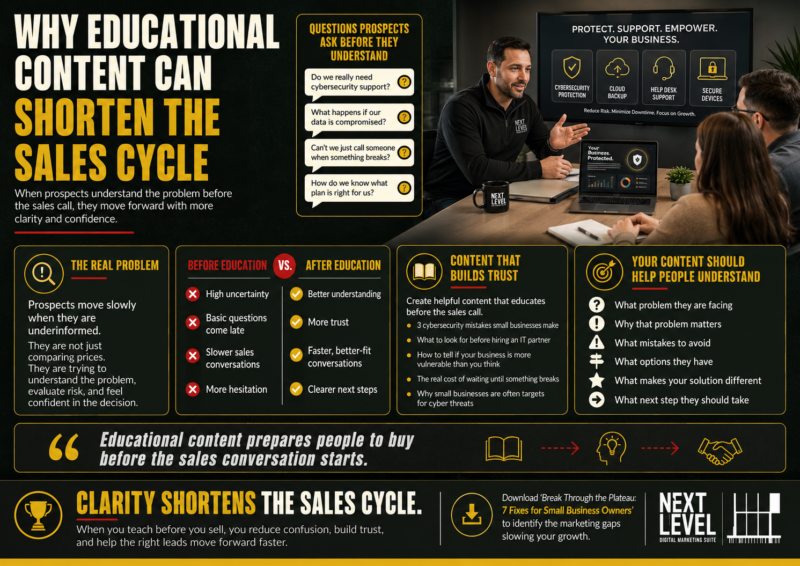
Why Educational Content Can Shorten the Sales Cycle for Small Businesses
For many small businesses, the sales process does not drag because the offer is weak. It drags because the prospect is still confused.
They may like what you do. They may even need what you do. But if they do not fully understand the problem, the risks, the options, or the value of your solution, they hesitate.
That hesitation creates a longer sales cycle.
A great example is a managed IT provider that serves small businesses. The company may offer cybersecurity, help desk support, cloud services, data backup, and ongoing tech management. But many prospects do not know what level of support they actually need. They may not understand the risks of weak passwords, outdated systems, poor backup processes, or unsecured devices.
So by the time they enter the sales conversation, they are still asking basic questions like:
“Do we really need cybersecurity support?”
“What happens if our data is compromised?”
“Can’t we just call someone when something breaks?”
“How do we know what plan is right for us?”
These are important questions. But when too much education happens late in the process, the sale slows down.
The Real Problem: Prospects Are Underinformed
When people are underinformed, they move slowly because uncertainty stays high.
They are not just comparing prices. They are trying to understand the problem, evaluate risk, trust your expertise, and feel confident that they are making the right decision.
That is a lot to process during one sales call.
Educational content helps solve this by preparing prospects before they ever reach out. It gives them the information they need to understand their problem, recognize the cost of inaction, and see why your solution matters.
In other words, educational content makes the sales conversation easier because your prospect walks in with more clarity.
How Educational Content Builds Trust Before the Sale
Small business owners are busy. They do not want to be sold to before they understand what is at stake. But they will pay attention to content that helps them avoid mistakes, make better decisions, or protect what they have built.
For a managed IT provider, strong educational content might include topics like:
- 3 cybersecurity mistakes small businesses make without realizing it
- What to look for before hiring an IT partner
- How to tell if your business is more vulnerable than you think
- The real cost of waiting until something breaks
- Why small businesses are often targets for cyber threats
This kind of content does more than fill a blog or social feed. It positions the business as a trusted guide.
Instead of saying, “Buy our IT services,” the company is saying, “Here is what you need to understand so you can make a smart decision.”
That builds authority. It reduces confusion. It helps the prospect feel seen, supported, and more prepared to take action.
Better Education Leads to Better Sales Conversations
When prospects consume educational content before reaching out, the sales call changes.
Instead of starting from scratch, the conversation can move faster into fit, priorities, budget, timeline, and next steps. The prospect already understands the problem better. They already see why action matters. They already trust that the company has expertise.
That does not mean every lead will close immediately. But it does mean the right leads can move forward with more confidence.
For small businesses, this is a major advantage. You may not have a huge sales team. You may not have endless time for long follow-up cycles. But you can create content that answers common questions before they become sales objections.
Your Content Should Prepare People to Buy
If your prospects keep asking the same basic questions late in the process, that is a sign. You may need more educational content at the top and middle of your marketing funnel.
Start by writing down the questions people ask before they buy. Then turn those questions into blogs, short videos, social posts, email topics, lead magnets, and website sections.
Your content should help people understand:
- What problem they are facing
- Why that problem matters
- What mistakes to avoid
- What options they have
- What makes your solution different
- What next step they should take
The goal is not to overwhelm people with information. The goal is to give them the right information at the right time so they can move forward with clarity.
Final Thought
If your sales process feels slow, it may not mean people are not interested. It may mean they are not clear yet.
And clarity is one of the most powerful tools your business has.
When you educate your audience before the sales conversation, you reduce uncertainty, build trust, and make it easier for people to say yes when the time is right.
Your business deserves prospects who understand your value before they get on the call. Start creating content that helps them get there.
Want to turn your content into a clearer path toward more leads, better conversations, and stronger customer trust?
Download the free guide “Break Through the Plateau: 7 Fixes for Small Business Owners” and start building a clearer path toward better visibility, stronger trust, and more consistent leads.